Beyond Aesthetics
How Neuroarchitecture Boosts Your Mood and Transforms Your Life
Close your eyes for a moment. Think about that feeling that washes over you when you enter a place and, without knowing exactly why, your shoulders relax. You breathe deeper. You feel the mental noise diminish, and an almost physical calm envelops you. It’s not magic, nor is it chance. It’s science applied to space.
At Neodomos, we understand that a house is not simply a container for objects or a financial investment; it is the stage where your life project unfolds. That is why when our architects face a blank canvas or a comprehensive renovation in the heart of Madrid, they do not only think about square meters. They think about how your brain will react to every stimulus, delving into the intrinsic relationship between architecture and emotions.
Today we want to talk to you about neuroarchitecture, the discipline that has ceased to be a future trend to become the standard of new luxury: emotional well-being through design. This philosophy connects directly with the trend of silent luxury in interior design, a form of design based on serenity, the authenticity of materials, and the beauty of the authentic and simple. A vision that, like neuroarchitecture, places your well-being and mental peace at the center of the design of every space.
What exactly is neuroarchitecture, and why should you care?
You may have heard the term, but it is vital to understand its depth. Neuroarchitecture is the invisible dialogue that exists between your neurons and the environment you inhabit. Recent studies in neuroscience have shown that architecture is not passive; spaces modify our brain chemistry, influence our hormones, and can enhance our creativity or, conversely, raise our cortisol levels (the stress hormone).
For you, who seek refuge from the city’s frantic pace, applying neuroarchitecture principles in your home is not an aesthetic whim—it is an investment in mental health. At Neodomos, we believe that true luxury lies in the space’s capacity to care for you. That is why our work philosophy focuses precisely on carrying out healthy architecture and neuroarchitecture designs and renovations.
Natural Light: Sculpting Your Circadian Rhythms Through Distribution
The first pillar of neuroarchitecture is, undoubtedly, light. Your body has an internal biological clock that is synchronized through sunlight. However, in protected historic buildings, altering the façade is not an option. This is where the true mastery of design comes in.
Poor lighting in constructed or gloomy spaces can affect your melatonin and serotonin production. Therefore, in our Signature Living projects, the key lies in optimizing the home’s distribution. We study how light travels to eliminate unnecessary barriers and create fluid paths, situating the areas of greatest activity where natural light strongly affects and reserving the dimmer areas for rest. Neuroarchitecture teaches us that light is the most valuable building material, and our job is to mold the space so that it reaches every corner harmoniously.
Height and Space: The Psychology of High Ceilings and Technical Integration
Have you ever felt oppressed in a room with low ceilings? Neuroarchitecture has an explanation for this. Various studies suggest that ceiling height affects our way of thinking: high ceilings foster abstraction, creativity, and a feeling of freedom.
At neodomos, we love old Madrid homes precisely for this reason: in their original construction, there was no eagerness to economize on height, prioritizing the human scale. Our challenge—and our passion—is to endow these homes with the necessary elements of modernity without sacrificing their essence.
We apply neuroarchitecture with an intelligent strategy: we sacrifice height only in transit spaces (hallways, foyers) to integrate air conditioning and climate control ducts. In this way, we manage to free up common areas and rooms, maintaining the original height where you truly live and enjoy it. We design with sense for current life rhythms, ensuring that your mind literally has space to fly, but with all the invisible technical comfort that the 21st century demands.
The Geometry of Well-being: The Balance Between Order and Fluidity
Your brain is a machine that constantly seeks patterns. The way we perceive lines defines how we feel in a space. Neuroarchitecture tells us that the geometric environment directly influences our state of alertness or relaxation.
At neodomos, we seek the perfect balance. We often use straight lines and an extremely clean design to provide visual order and geometry, something that generates profound mental peace in a chaotic world. An ordered space is an ordered mind. However, we are not afraid to break that rigor when the project calls for it. Sometimes, we dare to use curved lines and organic forms to provide a more enveloping and smooth character.
Whether through the purity of a well-executed right angle or the kindness of a curved wall, the objective of neuroarchitecture in our designs is always the same: that your gaze flows without obstacles and that the space embraces you, not attacks you.
Textures That Feed the Sense of Touch
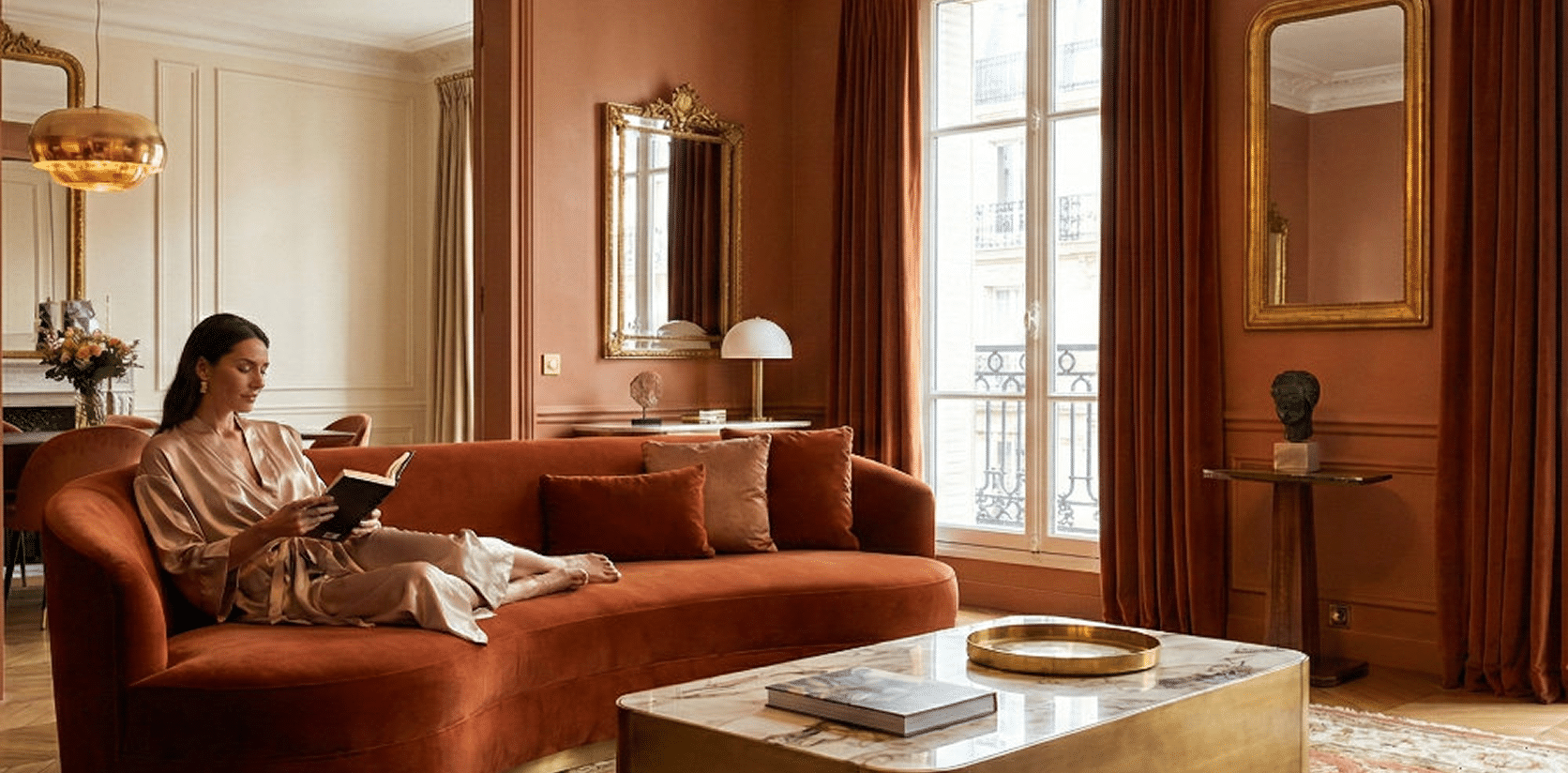
We live in a world of smooth, cold screens. Your brain craves texture. Neuroarchitecture reminds us that touch is a fundamental sense for feeling “at home.” Natural stone with its imperfections, brushed oak wood that tells a story when you run your hand over it, matte finishes…
Incorporating materials with a high tactile load reduces stress. This is what we call “sensory richness.” A neodomos home never feels like an untouchable museum; it is designed to be lived in. In fact, one of the most outstanding points of our designs is the balance between healthy interior design and neuroarchitecture: a combination that validates that surrounding ourselves with noble and natural materials connects us with the earth, anchors us in the present, and allows us to achieve full well-being.
Color and Your Mood According to Neuroarchitecture
Color is vibration, and your brain reacts to it instantly. Far from bright colors, the palette that defines the neodomos style usually moves in warm neutrals, earth tones, greige, and broken whites.
Why? Because neuroarchitecture indicates that these tones are the ones that cause the least visual fatigue and the ones that best serve as a canvas for your life. We do not seek for the wall to be the protagonist, but for it to be the harmonious background that allows you to relax. However, the strategic use of colors with more character in certain points can create sophisticated experiences, playing with the perception of depth and intimacy.
Your Home as a Refuge: Connecting with Nature
Finally, we cannot talk about neuroarchitecture without mentioning biophilia. This involves integrating the essence of nature into domestic architecture.
Unobstructed views, the use of biologically sourced materials, and the creation of suitable corners for indoor vegetation reduce blood pressure and improve concentration. In an urban environment like Madrid, your home should be your oasis. Neuroarchitecture is the tool we use to shield your inner peace against the external chaos.
Designing with Intention and Thinking About Your Emotions
In the end, the difference between a beautiful house and a home that changes your life lies in the intention. At neodomos, we do not draw a floor plan or choose a material without first asking ourselves: How will this make the person who lives here feel?
Neuroarchitecture is not an added luxury; it is the basis of our design philosophy. Because you deserve to live in a place that not only speaks of who you are but also cares for who you want to be. Your home is your third skin, and taking care of it is taking care of yourself.
If you want to see how we apply these principles in reality, we invite you to explore our selection of Signature Homes, homes ready to live in where science and art go hand in hand.